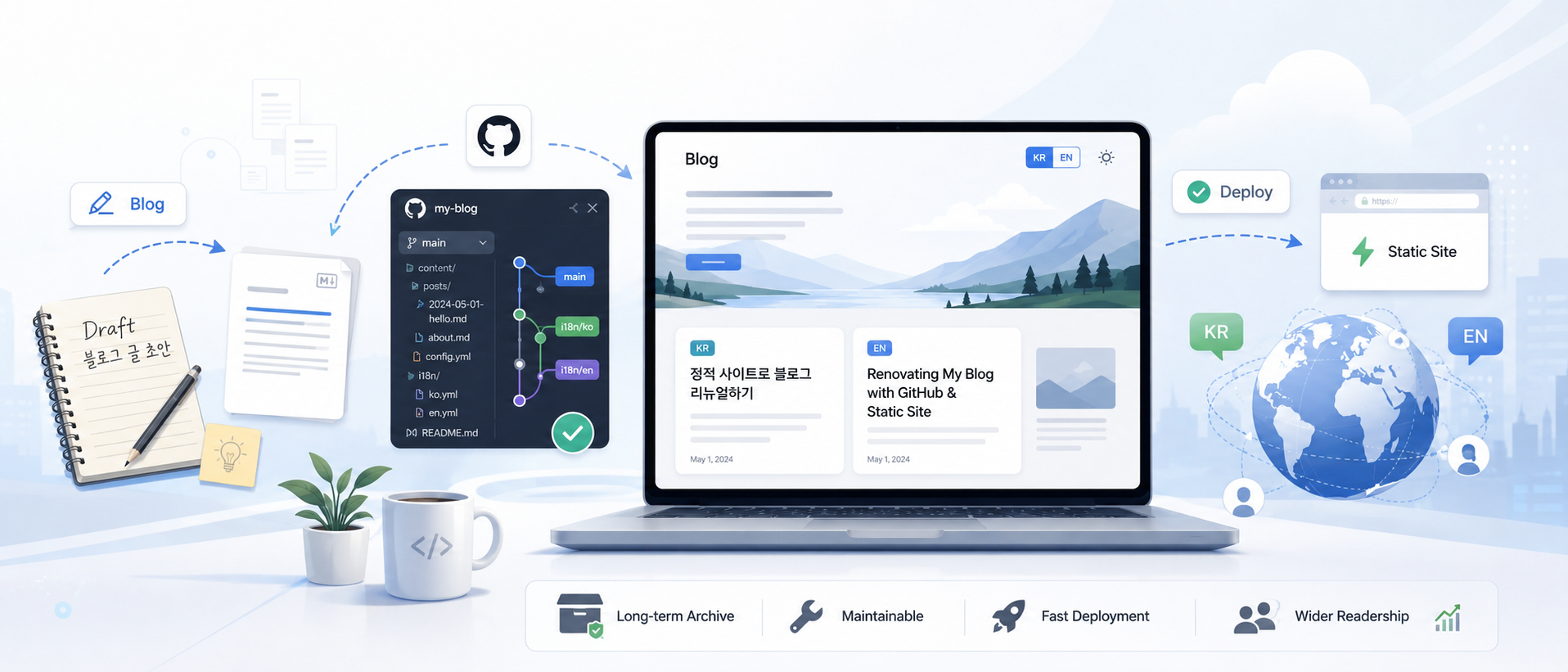
Today, I want to talk about why I decided to change the way I run my tech blog, which has been based on WordPress for quite a long time, to a new method.
Why I Rebranded My Blog
The most decisive factor was a security issue. While operating a WordPress blog, I was subjected to constant hacking attempts from overseas, and eventually, I was actually hacked. In the process of moving to another platform, I even experienced the loss of a large amount of images due to an error.
After that incident, I gave up running my blog for a while. However, as time passed, I thought I needed to write again, so this time I decided to properly set up the structure from the beginning.
Aside from security concerns, I also wanted a way to manage my growing collection of posts more reliably. I felt that if I could reach not only Korean readers but also English readers, the value of keeping these records would be even greater. What I needed was a structure that balanced maintainability and scalability, and as the answer, I chose a GitHub-based static website.
Deploying Static Web Pages on GitHub
GitHub Pages is a feature that allows you to easily serve files uploaded to a repository without a separate server. It eliminates the need to manage a server directly, significantly reducing the risk of hacking and making maintenance much lighter.
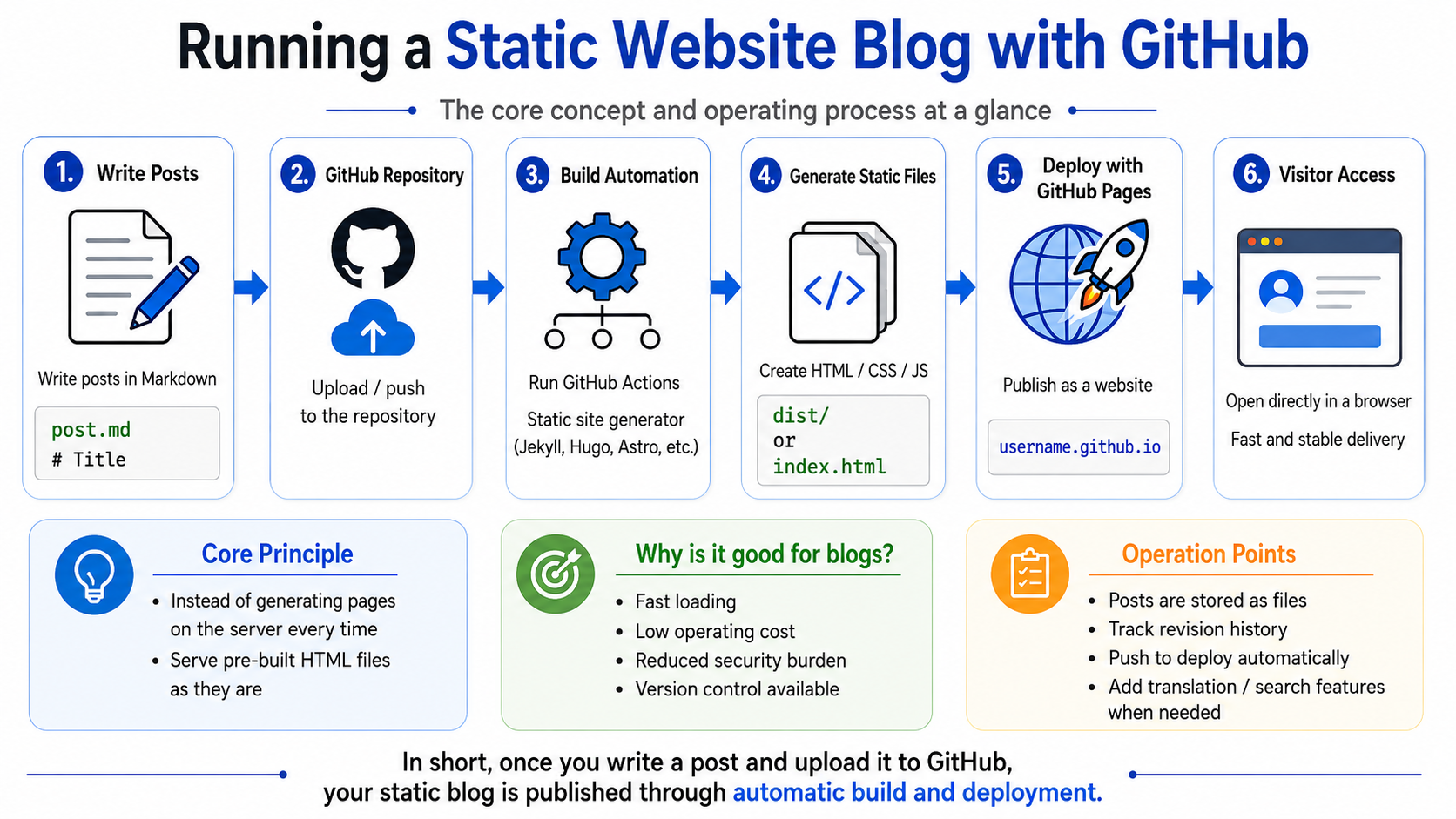
After writing and editing, changes are reflected quickly, and more importantly, it can be operated without a separate server, making it much better in terms of stability. As a result, an environment has been created where I can focus more on writing than on infrastructure.
However, there is one limitation. According to GitHub policy, private repositories cannot create pages that are publicly exposed. To use this feature, a GitHub Pro account is required, and luckily I happen to have a Pro account, so I was able to proceed without any issues.
Especially, instead of handling this process manually, I automated the work and deployment by utilizing my own built AI system. Thanks to this, I can operate much more efficiently.
Reasons for Adding a Translation Feature
The reason for adding translation functionality to my blog is simple. Even if it is the same article, the readers who can reach it changes significantly depending on the language. Technical records or open source projects can connect with many more people than expected, provided they just overcome the language barrier.
Translation is automatically processed using AI, and the structure is set up to provide an English version as well. While not yet perfect, having laid the foundation for multilingual operation alone has significantly expanded the blog's usability.
Future Plans
This redesign is more of a starting point to be continuously refined than a finished product. Going forward, I plan to further organize the structure of my posts and gradually improve the screen readability and translation quality.
I think the process of rebranding my blog itself is a record. I look forward to the attempts of today becoming a good foundation when I look back later.