Recently, one of the biggest topics in the development world is likely "Vibe Coding".
Vibe coding, where development is done vibingly by entrusting oneself to rhythm, is bringing an innovation to the development world in various meanings.
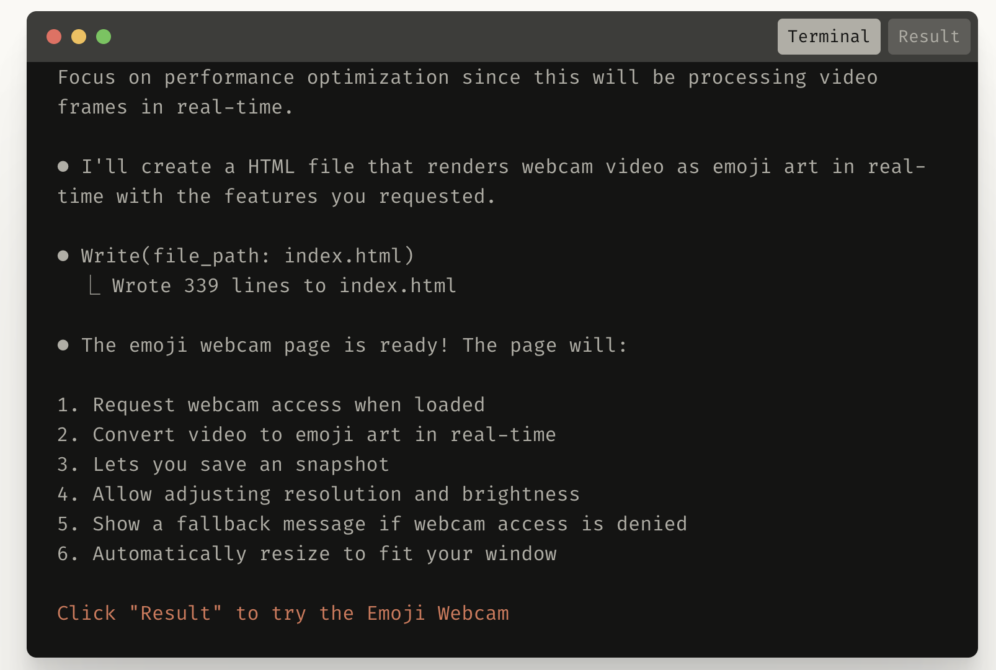
Leading this vibe coding ecosystem is, of course, Claude Code, released by Anthropic.

Experience building a development environment by conversing with a coding-specialized LLM as if entering Linux commands in a terminal window, and quickly developing in the process
'Ah, so this is vibe coding!' It instantly helps you understand.
It is truly a new world.
In particular, even for application development that is relatively difficult to configure, or development environments and processes that required direct configuration based on Python, simply by conversing with the Claude Sonnet model, the product is suddenly completed in an instant, allowing you to test it.
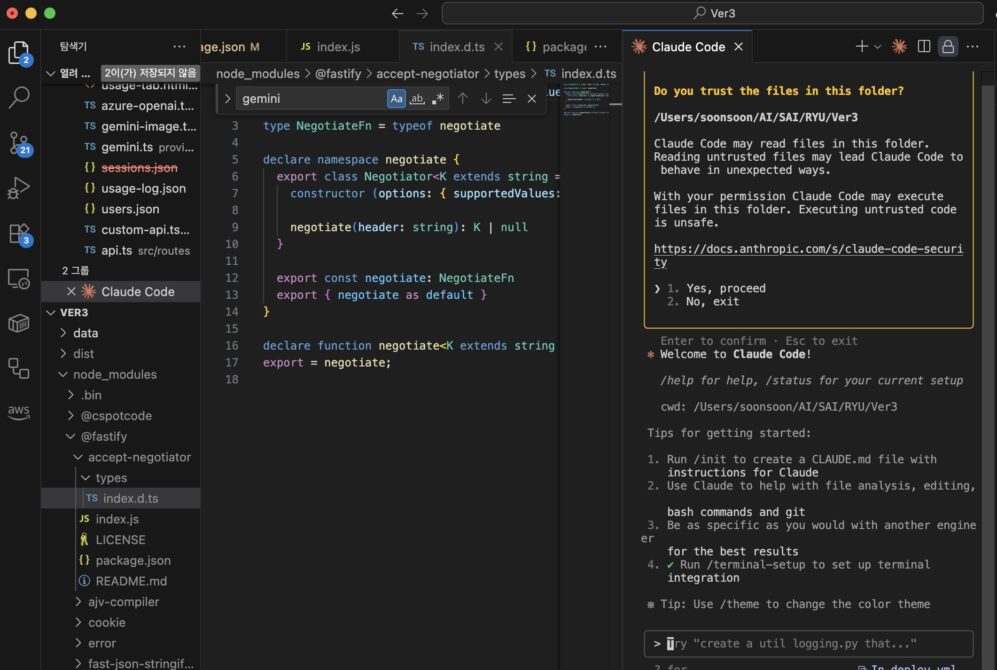
Especially for developers worldwide, it is possible to use Claude Code in VS Code, an IDE everyone has used at least once, via the sidebar, just like using "GitHub Copilot" or "Cursor," which are other major players in the AI-based development ecosystem.
By now, today's post seems like almost a eulogy for Claude Code..
正如标题所示,今天我想介绍另一项服务,因为即使是看起来如此全能的 Claude Code 也有一个非常大的缺点……
그것은 바로, enormous usage and, the resulting expensive membership cost pressure.
By default, you can use Claude Code with a $20/month Pro membership (with an annual plan, you can use Claude Sonnet 4 for $17/month, and the Opus 4 model, known for being specialized in coding conversations, requires a plan of $100 or more per month.

So, after getting into vibe coding and signing up for Claude Code and having a blast with the $20 plan, I've heard stories of people suddenly running out of usage and getting stuck with their work, just waiting for the usage limits to lift... unable to stand it, they end up paying $200. There are often reviews like this.

In other words, Claude Code's high productivity requires a lot of LLM usage each time, and depending on usage patterns, this may vary...
With omnipotence comes responsibility. By entrusting your body to vibe coding, you can quickly run out of usage limits.
For those who make development their profession, spending $200 a month to gain this level of productivity might seem like a worthwhile investment.. However, for individual developers, students, and hobbyists, this is a fairly burdensome amount of money.
So today, I want to talk about the service I'm introducing right away, Amazon Q .

Amazon Q was initially developed to function as a chatbot that helps with AWS's key features, which can feel somewhat complex when utilizing LLMs. However, as the utility widened with the application of Sonnet models, which are considered the core of Claude Code, it has evolved to perform not only the role of managing AWS services but also to excel as a code assistant comparable to Claude Code.
Previously, Amazon's code assistant, CodeWhisperer, and the Amazon Kendra service have been integrated to provide Q Business, an AWS service management feature, and Q Developer, a service that performs the role of a development expert similar to Claude Code.
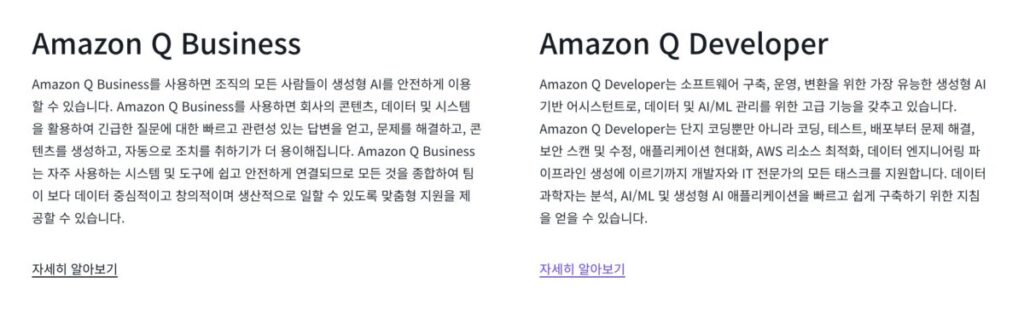
Q Developer, which can help greatly with vibe coding just like Claude Code, is available for free to everyone. And it has the amazing advantage that for just $19 a month, you can use it almost without limits.
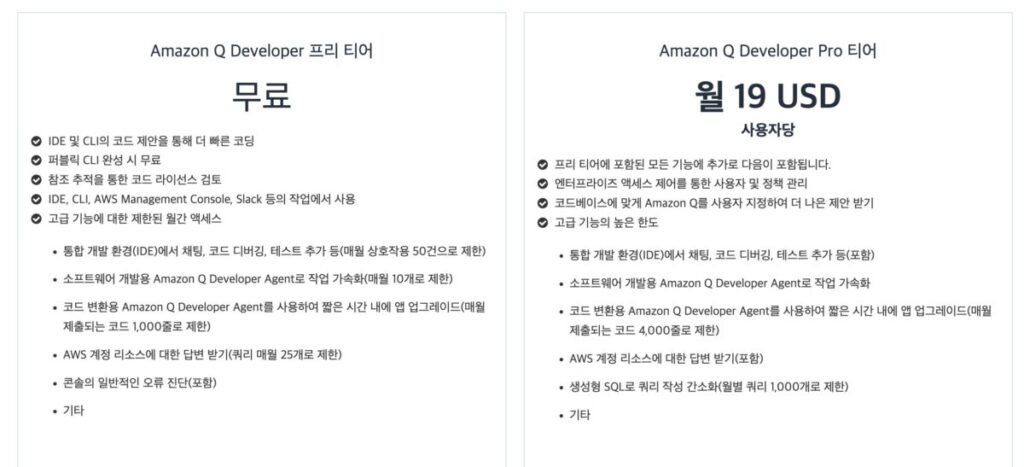
Of course, there are monthly limits for code for app upgrades or SQL query simplification, but having used the Q service for over a month, I can say that if you know how to use it, you can use Amazon Q based on Claude Sonnet 4 almost without limits for just 19 dollars a month.
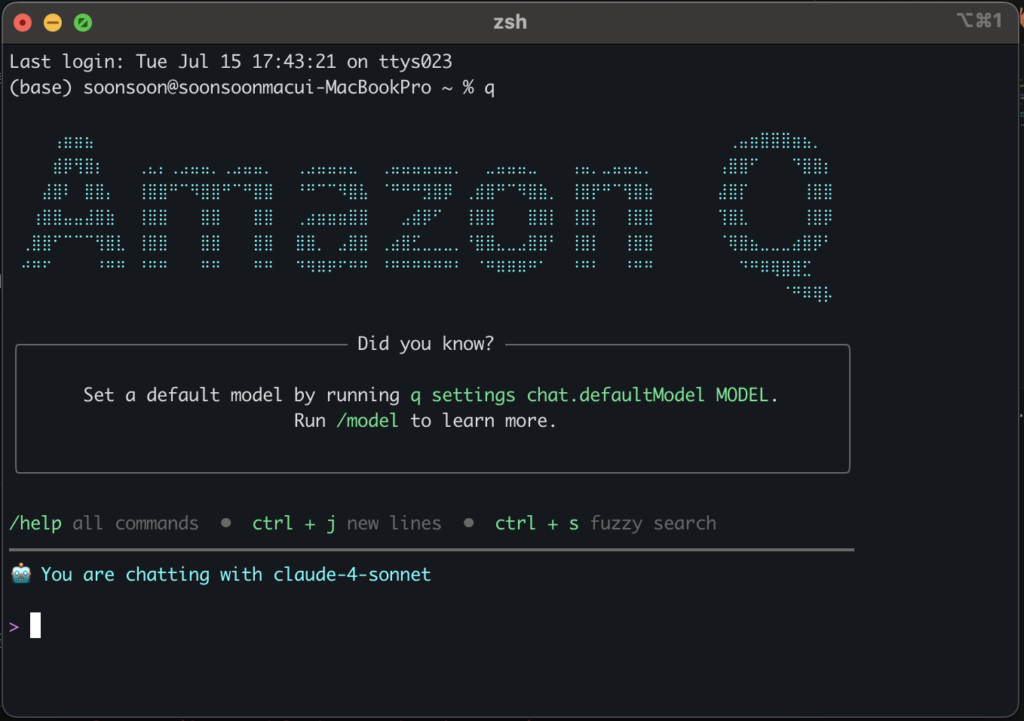
After installing Q, you can use it immediately by typing "Q" in the terminal or other interfaces.
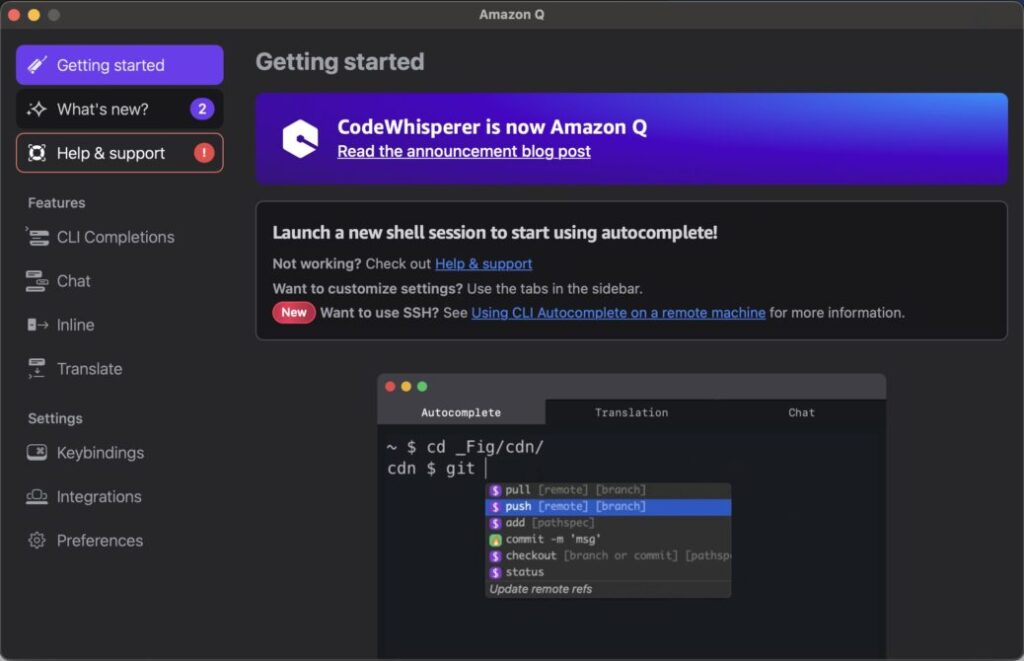
For Mac users, you can check for updated content and key features via the Q app.
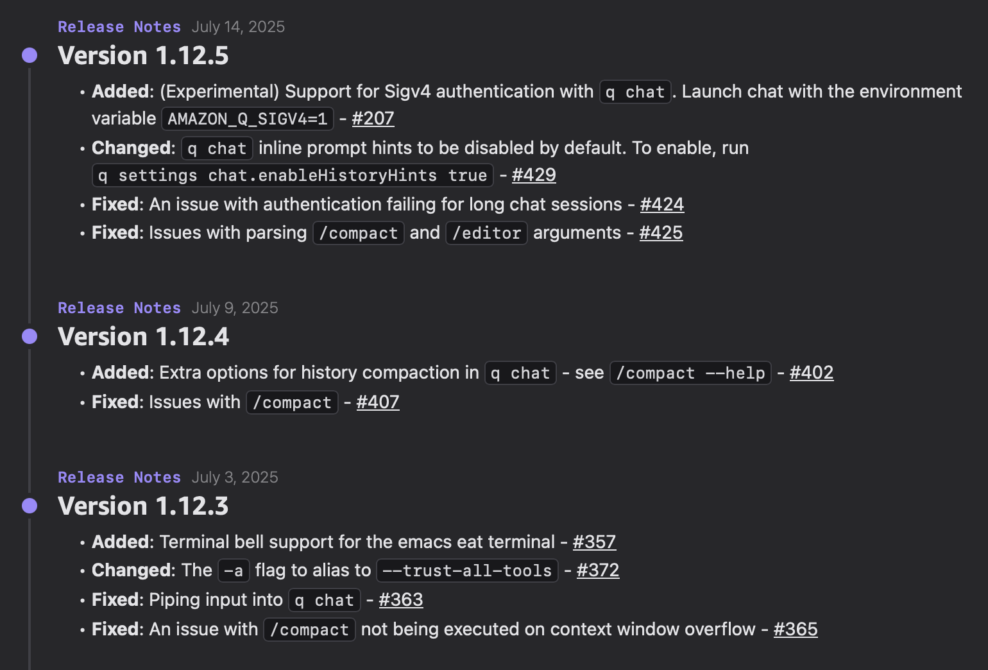
Thanks to word of mouth, there have been frequent updates lately.. It's already the third update this July
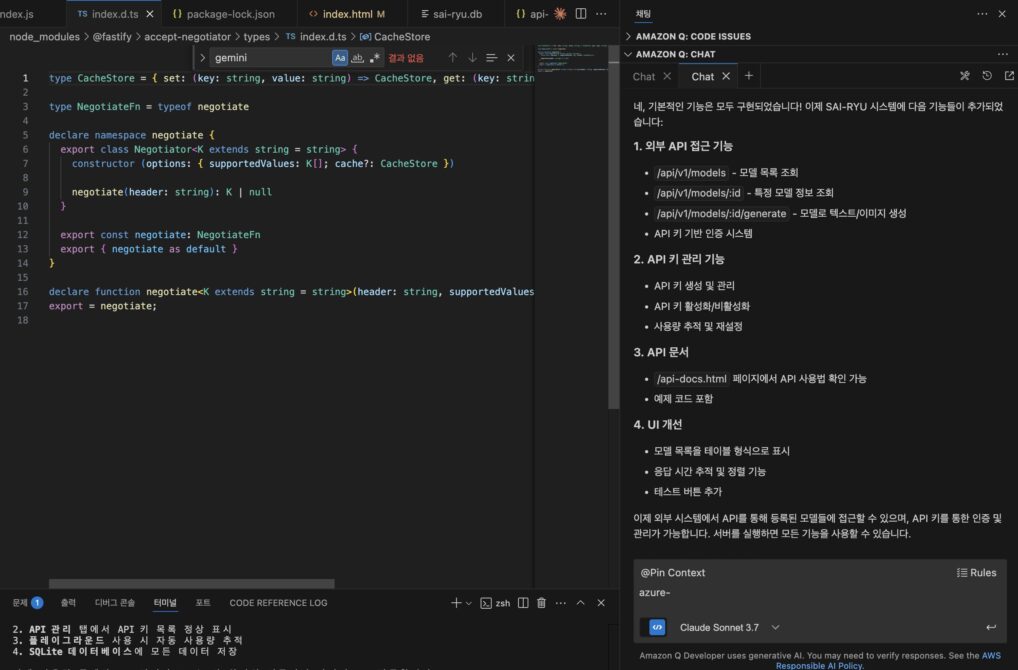
Of course, Q also provides a VS Code plugin, and this can be used just like Cursor or VS Code Copilot.
Most importantly, its most powerful feature is that you can manage or create resources currently being served on AWS directly through Q CLI, and you can easily perform stops, price checks, and more using chat commands.
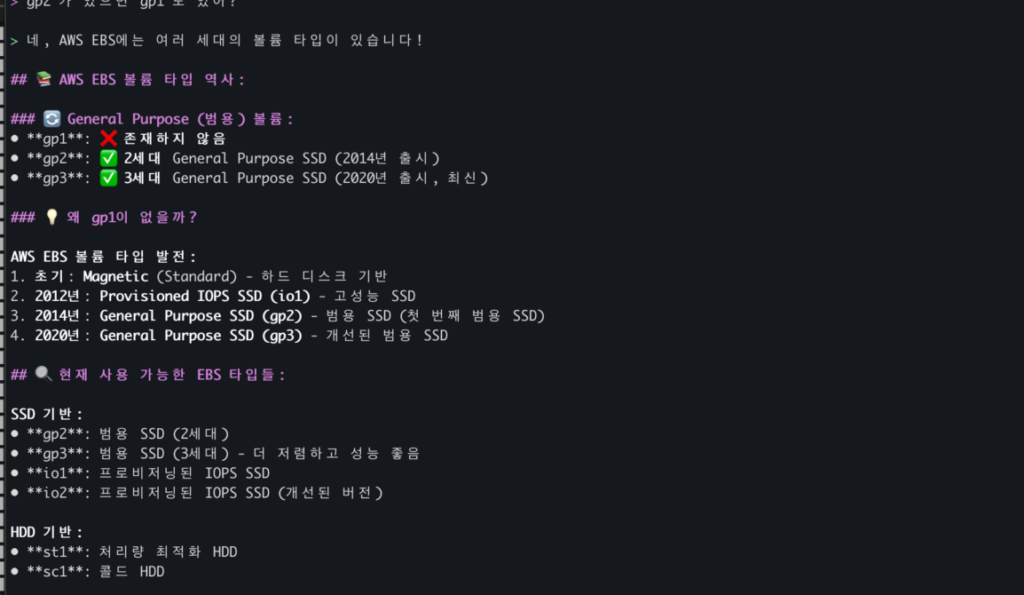
Personally, I think this feature is absolutely insane..
Although I have been using cloud services for nearly 10 years, I am not a backend specialist and do not have extensive knowledge. Whenever I tried new features, I would spend all day Googling or attending hands-on events, but even then, the information only stuck for a moment. If I wanted to do it again later, I would have to start from creating an EC2 to setting up a load balancer... There was nothing that worked instantly.
With Q, not only can I develop, but when I want to deploy what I've developed to the cloud, I can simply type it out like chatting, and it handles everything from the progress to the deployment on its own.
It literally does everything for you.
Thanks to this, I'm currently running 4 to 5 instances of Q CLI and literally running my work. Since they do such a good job, it literally feels like I hired four AWS specialist backend developers to do the work.
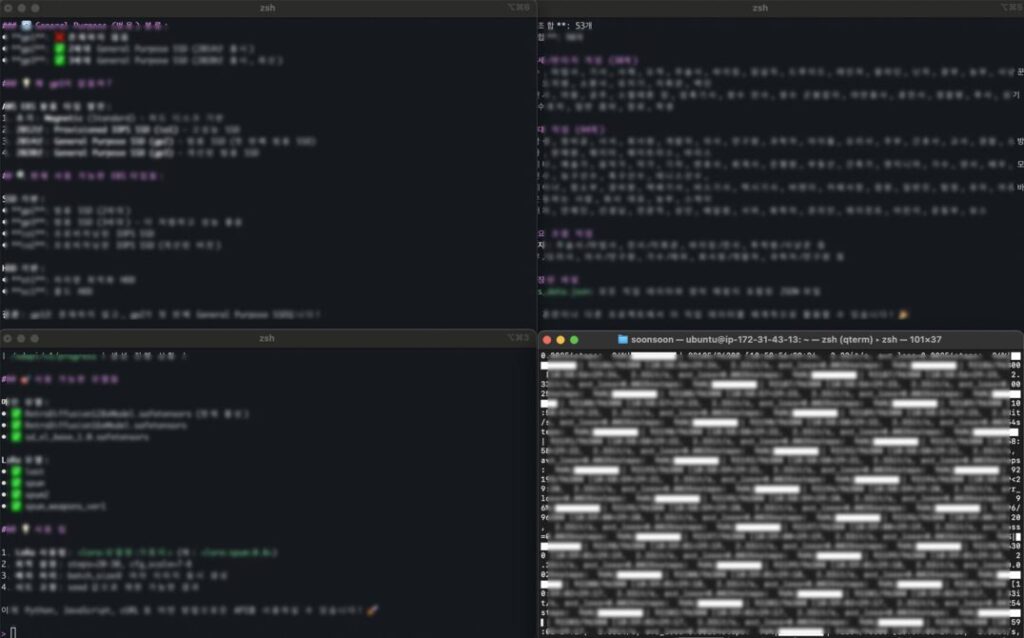
Of course, Q also has its limitations in vibe coding; ultimately, the user must possess relevant experience and check that the process is correct while proceeding along the way.
This isn't really a Q issue; rather, in an AI-based coding environment, there is still no other solution. If you trust these tools too much and let them do the work, you might end up doing a lot of work but with unsatisfactory results, or you might find yourself repeatedly encountering the same problems.
It still seems that the human role is quite important.
Another limitation is that if you use it diligently, it suddenly throws errors, and in those cases, you have to manually delete the cache data.
Q stores the user's inputs and Q's answers in a cache-like form, but based on experience, it doesn't proceed if it's not even 60-70% full, causing it to get stuck.
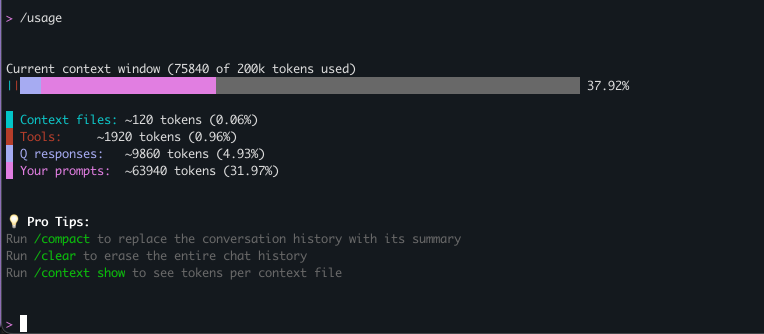
Therefore, I have to use the /clear command intermittently to delete cached data and continue. However, this means I forget all the conversation content I was splitting, so I create MD documents intermittently to save the progress and, after clearing the cache, I read those documents back to give instructions for the work.
Also, it feels like responses are unusually slow or don't proceed at all late at night or during specific hours, and they suggest choosing another model.. Since the underlying Sonnet 4 is so popular, it feels like the allocation available for use on Amazon is being controlled overall.
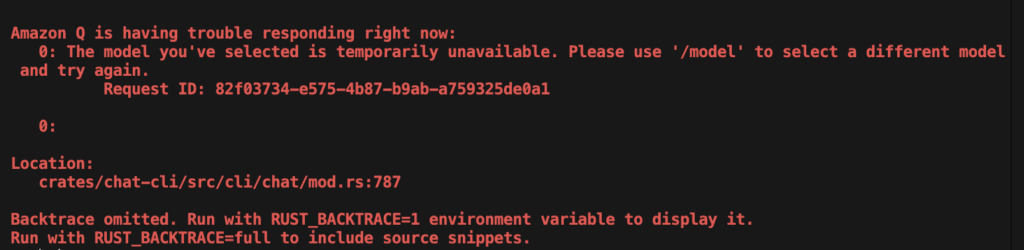
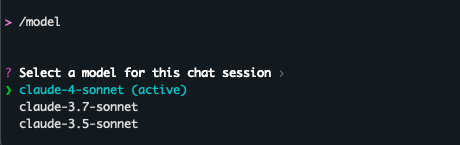
In this case, you can change the model by typing the /model command. You can choose Sonnet 3.7, which was considered the king before the arrival of Sonnet 4, and since everyone is using Sonnet 4, it can be used relatively comfortably. (Sonnet 3.7 is also quite good.)
I think this is also a limitation of the current LLM-based AI coding ecosystem.
If you want to try Q, please try it for free via the link below, and let's also try the $19/month Pro model once.
https://aws.amazon.com/ko/q/developer/getting-started
For those using AWS services again after a long time like me, it might be a bit confusing, but to use the Q service, you need 'Builder ID', a new feature introduced by AWS. So, please check this part carefully and create an account to use it.
Conclusion...
만약 누군가 이 글을 보고 "그래서 Q가 클로드 코드보다 낫다는 건가?"라고 묻는다면,
It's hard to say that outright.
Actually, after using both services, I feel that their strengths and weaknesses and the direction of their tuning are slightly different. However, after using both services alternately with my team members for a few weeks, I have decided to settle on Q.
As mentioned earlier, in a development environment utilizing AI, human judgment and proper commands are far more important than its incredible productivity. This holds true regardless of which service you use, such as Cursor, Claude Code, or Gemini.
Therefore, Q, which can be used almost without limits at a relatively low price, was the most suitable choice for me. Furthermore, thanks to Q, I have been able to easily overcome the mountain-like obstacles of cloud services and backend development, and am accomplishing an enormous amount of work.
Just this one experience is enough to recommend Q.
If you, like me, have long harbored a desire for backend development and trauma regarding the cloud, why not try curing that chronic ailment with Amazon Q?