Ultimately, a new pricing plan was announced again in just two weeks.
It appears that Unity's revised pricing plan, which faced severe backlash over the past two weeks, has been announced again.
For those who are unaware of the past events, please review the article below.
 soonsoon
 soonsoon
 soonsoon
It appears that Mark Whitten, head of the Create Solution which oversees Unity's subscription pricing plan, wrote an apology and discussed Unity's new pricing plan and direction.

What was announced
The key points are as follows.
- Apology to Unity Members
Sorry. We did not listen to the stories of Unity members. - Personal (Free) Plan Summary
1) The runtime fee does not apply to the Personal plan.
2) The revenue threshold for using the Personal plan has been lowered from the previous $100,000 to $200,000. If this amount is exceeded, Pro plan or higher must be used.
( It is probably based on revenue over the last 12 months, could be cumulative. Not yet confirmed. )
3) We will change it so that the forced Unity logo, which had to be forcibly added for Personal plan users, can be chosen rather than forced. - Runtime Fee Plan Summary
1) Pro and Enterprise users must pay an additional charge according to the runtime fee policy if they generate over $1 million in revenue over the past 12 months.
2) The billing method is a minimum of $0.005 to a maximum of $0.15 per download, and is determined differently depending on the plan used, the number of downloads, and the service region.
3) However, the above amount does not exceed 2.5% of maximum revenue, and in the section where the runtime fee applies, the lesser of the per-download charge and 2.5% of revenue is charged.
4) The per-download charge is calculated based on information submitted by the user by default, and if not submitted, it is estimated based on data collected by Unity and data collected by Unity's partners.
5) A download means "first install" and downloading multiple times on the same platform or downloading on different devices is not counted. Also, downloads for illegal purposes, education, etc. are not counted.
6) This plan applies from the use of Unity versions released after 2024, Unity 2023 LTS (scheduled for release in 2024), and does not apply to games or apps created with older versions.
This seems to be about the right amount.
Since I didn't understand it all at once, I reviewed and summarized it multiple times, so please understand that I may still be misunderstanding some parts.
For specific details, you can check the pricing page.
https://unity.com/pricing-updates
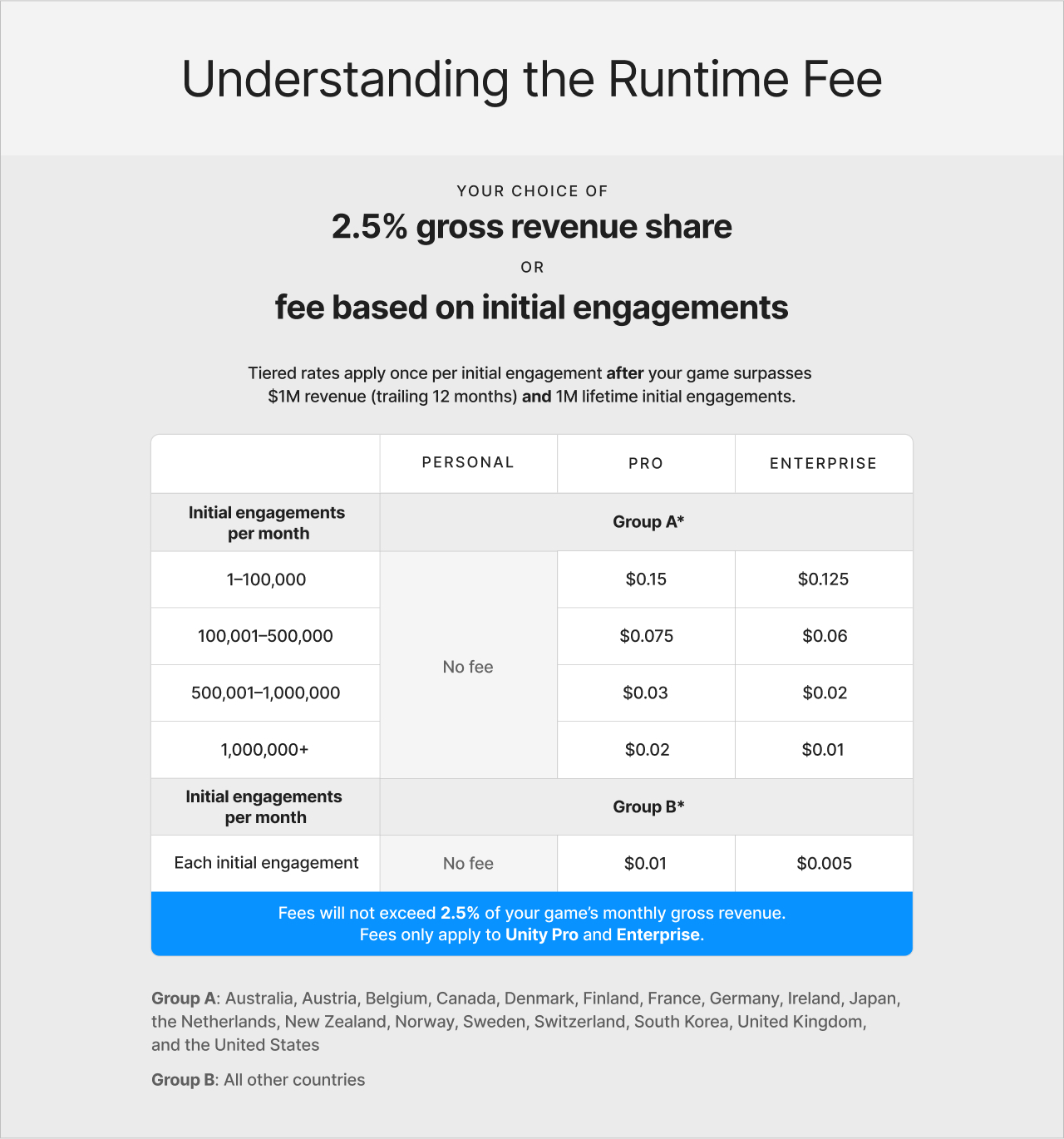
Essentially, it appears to be a move to share revenue from companies earning a lot of money with Unity while reducing the burden on indie and individual studios with little or no revenue, and actually offering more benefits than before. Additionally, since existing developers' games are not subject to the version, it appears that it will not be applied retroactively.
Will the Pricing Plan Controversy Finally End?
I had to read it several times because I couldn't understand the content all at once.
And after understanding it to some extent, it is welcome content for indie and small development teams generating under $200,000 (approx. 230 million KRW) in revenue over 12 months, but it appears to be a policy requiring revenue-generating companies that have already paid for the relatively expensive Pro and Enterprise licenses to share up to 2.5% of their revenue with Unity, so controversy is expected to persist.
- What is the basis for the figure of 2.5% of revenue?
- Why is Unity obsessed with charging per download?
First, here is the first point.
After this issue broke, Unreal mocked Unity, stating that they do not have complex details and only receive a 5% royalty on revenue once a certain amount is reached.
 아시아타임즈
Is this intentional? Unity's new pricing plan proposes taking 2.5%, which is half of 5% of revenue. In contrast, Unreal's standard for the free tier is $100,000, but they set it at $200,000, which also appears to be a choice heavily influenced by Unreal.
However, unlike Unreal, Unity's Pro and Enterprise plans require paying a significant cost of about 2.5 million KRW per year per seat, rather than sharing revenue after free use.
Therefore, for companies that have generated over $1 million in revenue over the past 12 months, they must additionally pay up to 2.5% of their revenue to Unity, so additional expenses will be incurred.
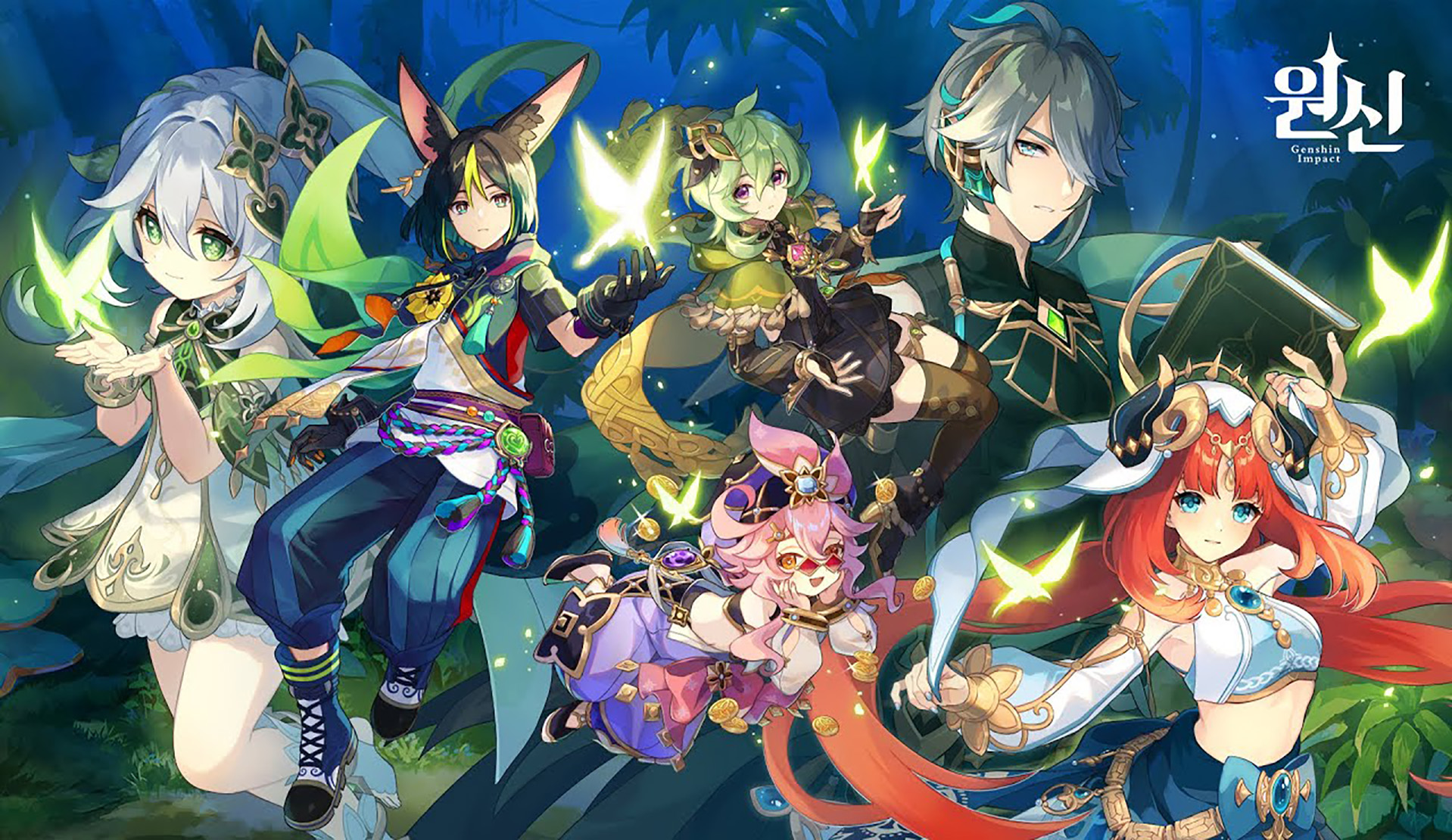
But then, for Genshin Impact, which is known to have generated massive revenue using Unity, it is estimated that about 7 trillion won in sales occurred as of 2022.. If that sales standard applies and similar sales are generated in 2024, that would mean paying Unity a whopping 175 billion won..
Of course, since Genshin Impact won't be using Unity's new version released in 2024, it wouldn't apply to it, but..
If a development project with the potential of Genshin Impact is being made using Unity and is scheduled for release in the first half of 2024.. I think they will seriously consider whether to release the project or even consider changing the development engine now after seeing this.
Also, while still having low ARPU, hyper-casual games that boost downloads and revenue through high advertising may think carefully about this policy revision.
Next is the second point: why the policy of charging per download is being maintained..
For charging per download, accurate measurement is essential. However, looking at the newly added content again, Unity broadly answers that it measures using methods other than its own statistics. In other words, it appears there is still no specific content.

In the internet and mobile markets, user metrics (visits, downloads, purchases, churn, retention rates, etc.) are extremely important information. And they are constantly evolving to improve accuracy. Nevertheless, excluding platform operators (Apple App Store, Google Play Store), I believe no one can accurately estimate 100% accurate download numbers.
However, why is Unity still talking about download-based pricing?
We can probably infer the answer from the story about <Runtime Fee Credits> that also survives in this pricing explanation article.

Therefore, it seems Unity is still planning a strategy to utilize the services of the existing Grow solution to increase revenue in the Create solution area.
I don't know much about it, but do you still think that strategy is really cool?
On the positive side, if they say that utilizing the Grow solution area, which they have built with effort and is generating revenue quickly, helped with the pricing policy for the engine subscription service.. I think it is definitely a direction that will be helpful for the company's business model.
However, the question is whether it was necessary to choose such a difficult method.
Isn't it enough to offer a discount to Unity users among customers using the Grow solution who generate over $1 million in revenue and need to share?
Unity: "Um.. if revenue exceeds $1 million within 12 months, for downloads above the threshold, you must choose either a $0.02 per download charge or 2.5% of revenue, whichever is lower, and submit a verified estimate from yourselves or partners to us, and pay the fee directly... That's a bit unclear to us right now, but we believe we can resolve it with your help and effort.. Of course, it's difficult, and it received a lot of backlash... Instead, we are increasing the free benefits... Ah, the most important thing!! We have advertising solutions and game service solutions... If you use these for a fee, we will give you credits that you can use instead of paying the download fee!! Isn't that cool? If you use this, it will be much easier to calculate. So, please try our services."
vs
Seon-seon: "Oh! So you generated over $1 million in revenue over 12 months? Oh!! But if that revenue came from using our ad solutions, we will offer a discount on a portion of the revenue share amount based on the ad spend! So please use our game services and ad solutions!!"
Wait... doesn't it look simple and easy to understand at the end, and rather than adding benefits, doesn't it seem like they're giving them away?
I might be misunderstanding because I have a bad head, but.. I tried reading it several times and trying to understand, but I couldn't understand, so I wrote this out in frustration.
Conclusion..
Unity needs to make money. And looking at the results of its struggles over the past few years, it naturally needs to reduce losses and improve its revenue model.
As a Unity user myself, I hope the engine developer makes good money and continues to exist, rather than hoping they go bankrupt overnight due to a lack of funds. After all, among the countless Unity developers worldwide, is there anyone who actually hopes Unity will fail?
I wish this apology and the pricing change news had started with a discussion on the improvements Unity has made regarding its strange investments, development, and unnecessary costs up to this point, as that might have shown a little more sincerity.
I don't know if it's because I'm not very smart, but it's hard to understand exactly what Unity wants to do.. Still, I hope this helps console the angry Unity developers a little and allows us to look forward to Unity's future.
Please.