Wait? Unity apologized.
A few months ago, there was news about a pricing policy change that had heated up Unity developers. As a Unity user myself, I was shocked and wrote a long post about it.
 soonsoon
( Since it is too long, if you are reading this, please take two deep breaths before reading.. )
However, just a few days after writing this, Unity apologized for its previous pricing policy change and announced via X (formerly Twitter) that it would review it again.

Translating the above content through Google Translate results in the following.
We heard you. We apologize for the confusion and anxiety caused by the runtime fee policy announced on Tuesday. We plan to change the policy by listening to the opinions of our team, community, customers, and partners. We will share an update in a few days. We appreciate your honest and critical feedback.
The gist was that Unity would accept criticism from its users, apologize, and simultaneously announce updated policies soon.
And as of September 19, the date this post is being written, there are still no specific updates regarding the new pricing plan or its withdrawal.
Why Did Unity Apologize? 1. Users' Outrage
As a Unity user myself, I think the pricing policy Unity announced on the 13th was a historically foolish decision. Although they quickly apologized and hinted at a change, many Unity developers and employees have already been hurt, and Unity is still being criticized.
The atmosphere can be felt to some extent just by looking at the comments on the X post above.

Even some are mocking the apology, claiming it was written by ChatGPT. .. If it's real, this is kind of funny.. Why not use MUSE? (When I tried with Muse, I couldn't actually write an apology.. )

Unity aspired to leap from a game engine to a solution that implements and services various technologies. Ultimately, it appears that it only recognized its problems and apologized quickly after facing severe backlash from the developer pool and developer ecosystem that formed its foundation.
Unity is a development tool that, even as it evolves into a solution, still cannot gain recognition for its value without users. Therefore, the most important thing is the reaction of its users and customers.
But why did the executives or key personnel who decided on Unity's pricing policy not know about this? It is really hard to understand.
Why did Unity apologize? 2. Unity seems to be in a big dilemma.
Ultimately, concerns over the Unity pricing policy revision affected its stock price. After the initial announcement of the pricing revision, the stock price fell slightly, but as the news spread like wildfire, it once plummeted by nearly 9%.

Unity's quick apology likely had an impact on this stock price.
Unity's management has an obligation to represent the views of shareholders and drive up the stock price. This is especially true for a company as tightly bound to its future value as Unity.
However, the interesting aspect of this result is that Unity's management likely announced the pricing change to improve profitability, which should have been accompanied by expectations of rising revenue in the short term and a slight rise in stock price; yet, the stock has been continuously falling since the announcement.
It seems the management must be in quite a state of confusion..
However, to understand the management's stance of representing shareholders, we need to look at Unity's revenue status over the past few years to consider why they changed the pricing plan.
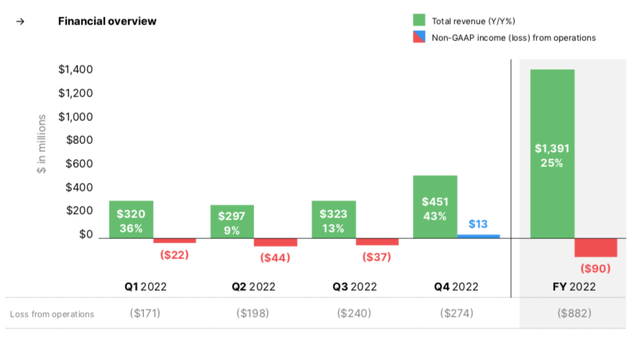
Unity is a company that has been consistently recording negative profits, with the exception of a single profit in the fourth quarter of 2022. According to published data, while sales increased in the first and second quarters of this year, it recorded a deficit in the profit section, suggesting that the profit in the fourth quarter of last year was likely a one-off event. (Reason unknown. What kind of magic was used.. )
Unity has been aggressively adding technology since its IPO and has been trying to create value through acquisitions and mergers. However, it seems that visible results have not yet been achieved.
So, I think this time they touched upon the engine subscription pricing plan, which can be considered the very foundation of Unity. And I think this is a method that the company's management, seeking to make a profit, should consider sufficiently.
However, I believe that method was largely incorrect.
It seems they announced without asking users for their opinions, checking the reaction, rushing, being ignorant, being reckless, and ignoring internal opposition.

Thanks to this, Unity appears to be facing its first major crisis since it began winning the love of many users.
这起事件似乎正在演变成一个典型的‘为了捉住一只跳蚤,却烧掉了三间茅草屋’的案例。
Will Unity's management be able to announce updates that can lift Unity's falling stock price and appease angry Unity developers?
Why on earth did Unity end up like this?
I believe Unity was a company and stock that greatly benefited from the "MetaVerse" and "Digital Twin" during the COVID-19 era.
From the second half of 9, the sudden arrival of COVID-19 and the concept of the MetaVerse, along with expectations that technology such as digital twins and digital formation would represent society, suddenly swept in. Due to COVID-19, we were forced to utilize the potential of unproven technologies.
In the midst of such social changes, Unity was a good choice for everyone to use easily, with a low technical barrier to entry. The global management team, consisting of those who left from EA and formed Unity anew after the major Western investors and the existing Unity management team stepped down, worked hard to promote Unity as the most suitable total solution for the new society and led the way, telling stories of a wonderful future.

Such expectations and the efforts of Unity's newly appointed management and staff led Unity to achieve the stock market success commonly known as a "listing jackpot" as a beneficiary of technology.


Indeed, since then, Unity has strived to create value over the past few years by utilizing the significant opportunity cost created through its IPO to develop and announce various technologies, and even acquiring companies when necessary.
Representatively, many companies that have occupied the market through significant technological investments, such as Autodesk, seem to have been making efforts to replace Unity with enterprise/research institute solutions.

From a personal perspective, I think this is an approach worth considering if you have the capacity.
Amidst the flood of technology, Unity was a great development tool that allowed for easy and fast demonstration of technology and was loved by many companies.
In contrast to software for individual users, commercial software based on technology used in corporate, research, and design sectors is very expensive per license, so if the strategy succeeds, it will also be a great help to Unity's revenue structure.

However, looking at the disclosed corporate data, Unity's attempts do not seem to have yet shown visible results relative to the investment.
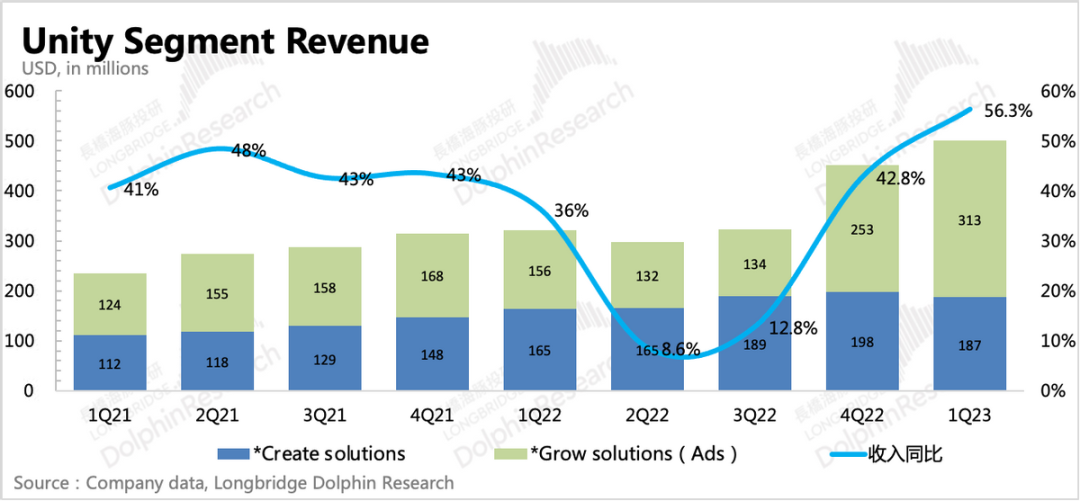
Although I need to examine the data in detail, the progress in the Create Solution area, which includes technical subscriptions/engine usage fees, has not improved significantly compared to the first quarter of 2021.
I hypothesize that this level of growth is likely not a metric driven by an increase in existing Unity paid users or the emergence of more game development companies generating revenue.
I personally do not believe Unity can replace existing technical solutions, because this field is not an area that can be replaced simply by the advancement of technology, solutions, or engines.
This is a field where the number of users who can utilize this technology must increase, and there must be enough experts to satisfy what each company wants.
For the solution business, the most necessary thing is professional personnel and infrastructure
In my opinion, Unity is still a "3D engine", not yet a "complete solution".
Games are engines developed for game development, while services or solutions provided and utilized for business or purposes differ significantly.
Solution services, as we commonly call them, should naturally be used according to customer needs, so they must be equipped with features that match the customer's experience, purpose, and usage.
Therefore, I believe that various solutions exist by field and business, and unfortunately, there is no all-purpose solution that can cover all fields.
Traditional technology solution companies invest heavily and dedicate themselves for a long time to developing technology, while simultaneously cultivating and operating specialized personnel capable of handling, promoting, and assisting customers with those solutions.

Therefore, it is difficult for a technology solution company to establish itself if it does not have a team of experts capable of promoting and supporting the solution, along with a variety of solutions tailored to the needs of the customers that these experts can utilize.
In other words, no matter how well-made a technology is, it can only be utilized if there are sufficient professionals who can use it comfortably and apply the solution to meet customer needs.
So, why does Unity think it is inappropriate in this area? I will discuss this using my own experience as a case study.
About 3 years ago. I received a call from the VR group of the research institute I worked at over a decade ago.
"When we signed the agreement with Unity, could we use this to replace the tools we use for our work?"
It was quite a shock at the time.
Because the author understood the work done by that department and well understood that Unity did not fit the tasks and goals they were pursuing.
It was like using a knife meant for catching chickens to catch rabbits.
Of course, I hurriedly searched and found that Unity had announced new technologies in related fields. However, it was difficult to find users or experts in that area. Furthermore, it was difficult to find solutions tailored and distributed for that specific field.
So, I tried my best to answer based on my own thoughts.
"Maybe you have to develop it yourself? Since Unity is a game engine... there are basic components for the work you are doing... but the basic specs might be lacking to do that work..
Open the source code for the 3D physics engine and tune it yourself or use it as a basis to directly develop the features you need... it might be possible... but how many people in our country can do that..? "
I remember answering that.
According to later reports, after several issues, Unity actually deployed engineers to implement the desired features for that team and proceeded with the work.. I'm not sure how the results turned out.
Since then, there have been a few more instances where they sought similar advice from other companies, educational institutions, and content providers, but every time, they were told, 'Well, they have no choice but to develop the functionality directly with Unity...'
Again, Unity started as a game engine.
Therefore, the current majority of Unity developer pools are based on game development; even if utilized for functional apps or solutions outside of games, they do not directly utilize the features Unity provides. Instead, they take the form of Unity users utilizing assets, plugins, etc., to directly create, sell, and service functionality.
Yes.
No matter how much Unity improves its features, ultimately, since Unity is based on a 3D physics engine, Unity developers must develop it themselves and implement the functionality.
And we call a person who has the experience, knowledge, and skills to do such work a professional. And there are not enough professionals with experience in the relevant field who have achieved results to become a technical solution.
Of course, Unity Korea is also performing some of those roles by gathering capable Unity users active in Korea under the title of Masters.

Looking at the history of Masters members, there are those with truly excellent careers, there are YouTubers I enjoy watching to see Unity's new features, and there appears to be a professor who has been active in the game field for a long time.
However, most of them seem to be those with a game-focused career. Additionally, they appear to be those who focused on visuals or built experience with lightweight features and projects. It does not appear that they possess the experience or know-how regarding the enterprise solutions Unity mentioned earlier.
Of course, this may be limited to the domestic market, and Unity may have an incredible group of experts globally, but it is unlikely that there would be so many experts in such a short time, and it would also be difficult for them to operate in the field while responding to the entire world.

If that had happened, technical advice wouldn't have come my way multiple times even for a nobody developer like me sitting in my room.. ( Was it just that I was cheap so they contacted me? )
No, basically, it hasn't been five years since Unity became a mainstream tool based on game development, so there aren't many experts in this industry. There might be some, but they will still be woefully lacking. It really hasn't been a few years yet.
This is not something that can be done in a short period of time.
In other words, Unity does not yet have the infrastructure of specialized personnel capable of covering the technical solution area.
Unity isn't the omnipotent, invincible total solution?
正如上文所述,通过周围人或同行了解到关于Unity的情况时,人们往往倾向于将Unity视为万能工具。
I think the results of Unity spending a lot of money to hold events, distribute press releases, and do sales had an impact.
That way, the sales team must have been working hard.
However, if we look at this positively and assume that Unity's research investments over the years have paid off, resulting in overwhelmingly good functionality that is almost all-purpose and has exceptional versatility.
After all, there must be users who can use that wonderful feature well for its value to become a reality.
Sometimes, when I see people claiming that Unity is a panacea, it sounds like they are saying this.
'You can build buildings or industrial equipment out of Lego!! You can do everything with Lego.'
I felt this way a lot.

And just like the picture above, imagine building buildings and cars with Lego, and even making airplanes. (How would you make them?)
Is that because Lego is so amazing? Is that because Lego Creator is so amazing? Those who can do that with Lego are likely to be a handful of talented individuals around the world... In that case, shouldn't we say it's the worker who is amazing, rather than Lego itself?
Unity has been communicating through various media that if you stay with Unity, you can produce amazing technical value in many fields.





Here is the most important part missing.
It is precisely the "premium user". Although emphasized, "expert infrastructure" is extremely important in the technical solutions field. No matter how much technology improves, the belief that technology alone is everything is truly dangerous. People apply and use technology, and if they do so poorly, the technology loses its value. That is why experts are important.
And one expert is not just dropped from the sky. It exists because technology is there, the user base is growing, the developer ecosystem is built, and through investing time to create amazing results, sharing and studying them, and receiving recognition, it is born.
I believe Unity still needs to focus on the foundational aspects such as building an ecosystem, cultivating professional talent, and sharing experiences.
How many people have actually tried out all the many technologies Unity has released? Even I, just recently posted a simple review of Muse AI, and I started getting contacted from all over to have me teach with it.. No, how am I supposed to do that. .I've only just started using it...
It seems people are misunderstanding how versatile Unity's tool and technology are.
Let me be clear: that never happened.
Unity seems to have forgotten its most precious thing.
Through this incident, I feel deeply that Unity's current management does not seem to understand Unity's core values.
Unity is an easy-to-use tool. And it is a tool that creators use to earn great value and big money, depending on their skills.
Therefore, Unity's greatest value is its developers and its developer ecosystem. Without excellent creators, Unity would not exist today.
Let me tell you a story based on one assumption to help you understand this.
Imagine a world of fantasy where there is a super-powered blacksmith, and this blacksmith creates a Dragon Slayer (Dragon-slaying sword) that is large and powerful, capable of defeating monsters just by swinging it.
Although the functionality is rough, it was loved by many adventurers because it could deal significant damage just by swinging it. Let's say the blacksmith supplied the Dragon Slayer on the condition of charging a low fee in exchange for improving the functionality.

虽然租赁武器使用起来有些棘手,但考虑到它是免费维修的,且租赁系统非常适合那种粗暴的使用方式,我们可以假设,随着用户数量的增加,出现了一批凭借出色的个人能力取得了惊人成就的冒险者。
But what if the blacksmith suddenly puts a gun on that weapon, or adds a invisibility skill... and then carries out upgrades that existing users can hardly sympathize with, while being praised as a cool technology only by non-users... and then decides to feast on the adventurers who really caught the dragon with Dragon Slayer (with individual ability.. the weapon is still just a blunt, hard sword..).
So, let's consider the policy they introduced next.
"From now on, we will charge a fee for every monster you defeat using the Dragon Slayer. A copper Dragon Slayer will cost $0.2, while a tungsten Dragon Slayer will cost $0.02 per kill."
Then perhaps the Dragon Slayer's next target will be that blacksmith?

So I think the management needs to be cut.
It may not be the most appropriate analogy, but thinking about it again, it is incomprehensible and infuriating.
마치며..
Whatever the case, Unity has apologized for its pricing policy, and now the situation remains with a new policy announcement, a retraction, or other details yet to be announced.
Even so, I think there would be no one to oppose it if Unity announced that it would raise its pricing plan slightly to improve its management, or that it would charge more for famous companies or major titles that are making a lot of money through Unity.
However, before they try to extract more costs from the existing cache cow, I hope there is a genuine story about Unity's future where they reflect on the fact that they have been investing in strange places all this time and improve from there, and further improve and develop Unity's core technology.
I suppose they won't be spouting nonsense about the Metaverse or Digital Twins anymore..
Unity hopes developers in its ecosystem never forget that they are the ones who create engines and services, and use them to implement and utilize the Metaverse and digital twins.