Today, I want to write a somewhat serious reflection on education.
Recently, I have been asked to participate in and cooperate with the AI Advanced Industry Talent Bootcamp project at three schools where I am directly lecturing, mentoring, or meeting.

To summarize what this project is, it is as follows.
It received help from Gemini AI.
- By working together, universities and companies create on-site tailored AI curricula aimed at training industry professionals who are truly needed.
- Through this, students reduce the gap between theory and practice to increase their employment competitiveness, while companies secure prepared talent early to reduce hiring costs and risks.
- Ultimately, this is a government-led Industry-Academia Cooperation innovation model aimed at resolving the chronic shortage of AI personnel and strengthening the competitiveness of the nation's advanced industries.
This project appears to be a bootcamp-type industry-academia cooperation support initiative where universities collaborate with companies to create curricula that allow students to grasp practical experience in line with the rapidly changing requirements of the AI market.
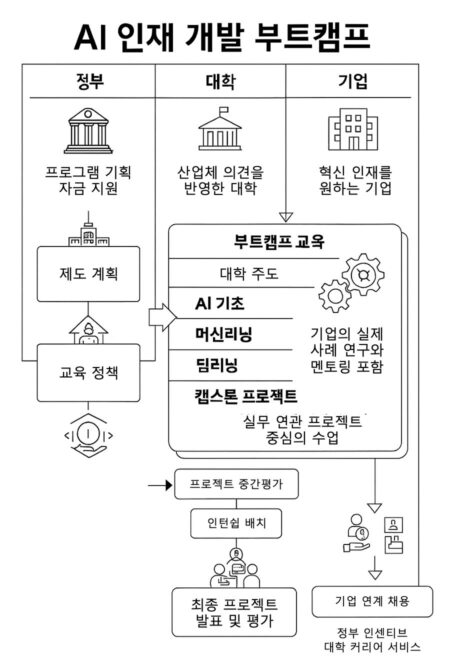
Considering that only three schools nationwide are selected, competition is expected to be fierce; however, schools that are already conducting related classes appear to be leveraging their existing databases to respond in tandem with partner companies.
Therefore, from my perspective of participating in programs related to universities for several years, I would like to summarize a few thoughts based on the specific content that has been disclosed.
1. The role of universities is changing. The final gate of the employment academy
More than 20 years ago, for me, who had the unusual experience of working on a war game development team in the military, the school curriculum felt quite awkward.
My major in mechanical engineering had a wealth of knowledge that could be actively utilized in simulation development and related fields, but the university's curriculum was not structured to consider this.

Later, by chance, I was able to convey my thoughts to a professor who was the head of a highly renowned department at the time. The professor's response to my somewhat complaining story was as follows.
"The knowledge you speak of is not what is taught at a four-year university, but what is taught at a practical, vocational college. The purpose of coming to school is different. If you need practical experience and specialized knowledge, go to a training center."
At the time, it was quite a shocking story, but at the same time, it was content that had a significant influence on the direction of my life thereafter. Afterward, rather than finding a way to gain professional knowledge at school, I tried to learn by working part-time, working at a company, and doing it myself.
And now, over 20 years later, the role of universities seems to have changed quite a bit compared to the past.
Considering life after graduating from university, most students seem to want to attend college hoping that their "livelihood issue" will be resolved by their diploma and what they learned there.
In particular, as the population has significantly decreased and universities were established based on the population growth of the past, universities seem to be increasingly in a situation where they must pay close attention to the needs of customers (freshmen) rather than playing the role of lofty ivory towers of learning.
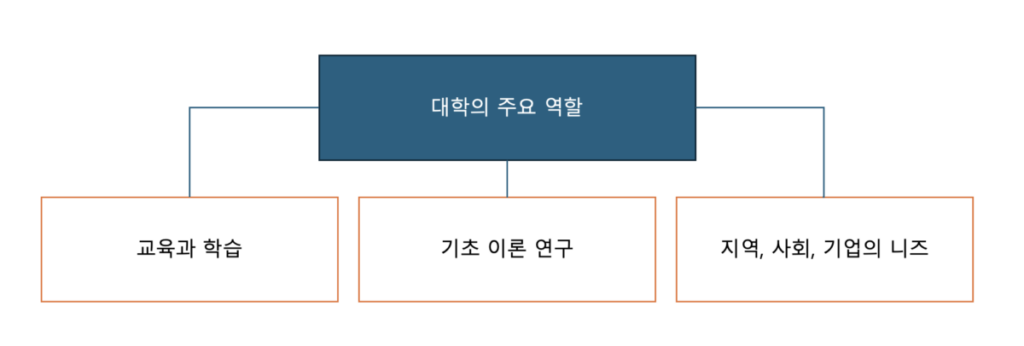
While it may be difficult to predict the future with 100% accuracy, there is concern that such changes will continue to accelerate.
From the perspective of having directly learned through 20 years of experience centered on practical work, there are some aspects that concern me, because the more experience accumulates, the more deeply I realize the importance of the fundamental academic disciplines.
Therefore, I believe that universities must evolve by remembering their essence while continuously improving and developing to meet the practical needs of students and help with employment, emphasizing the importance of practical disciplines from the current perspective.
Of course, many professors at universities in the field must be worrying about having to catch both of these rabbits... It makes me worry too.
Therefore, I hope this project becomes a good opportunity for schools and companies struggling with difficult choices in the field and considering investment opportunity costs.
2. Who can deliver the lectures to cultivate the talent that companies want?
Ultimately, for this project to function properly, the prerequisite is that companies identify the practical skills they require and that universities can provide learning processes tailored to those needs.
To achieve this, above all, good "programs" and "instructors" are important.
Reflecting on my experience over the past decade in the relevant field, unfortunately, there is a problem in our country where there are quite a shortage of instructors who can conduct specialized lectures compared to this demand, as well as related programs.
First, given that there are already few people capable of utilizing prior technology to handle practical work, those who satisfy the "intersection" of interest in practical work and education are bound to be even fewer.
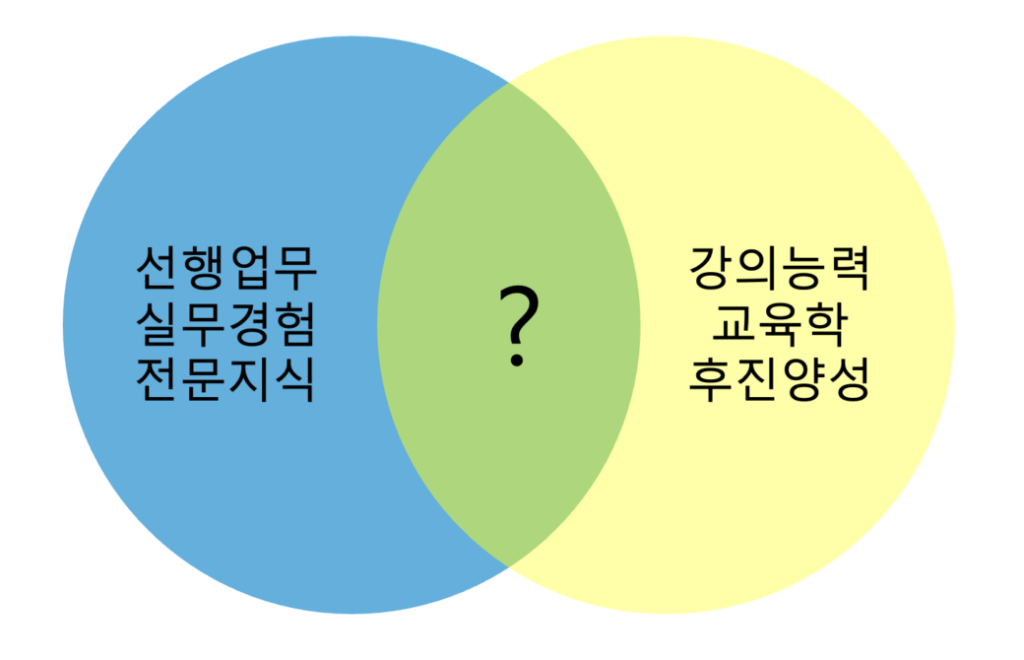
At least for large companies where resources are sufficient and they need to focus on new technology work, the situation might be a bit better.. However, even for large companies, cultivating such talent is not an easy task.
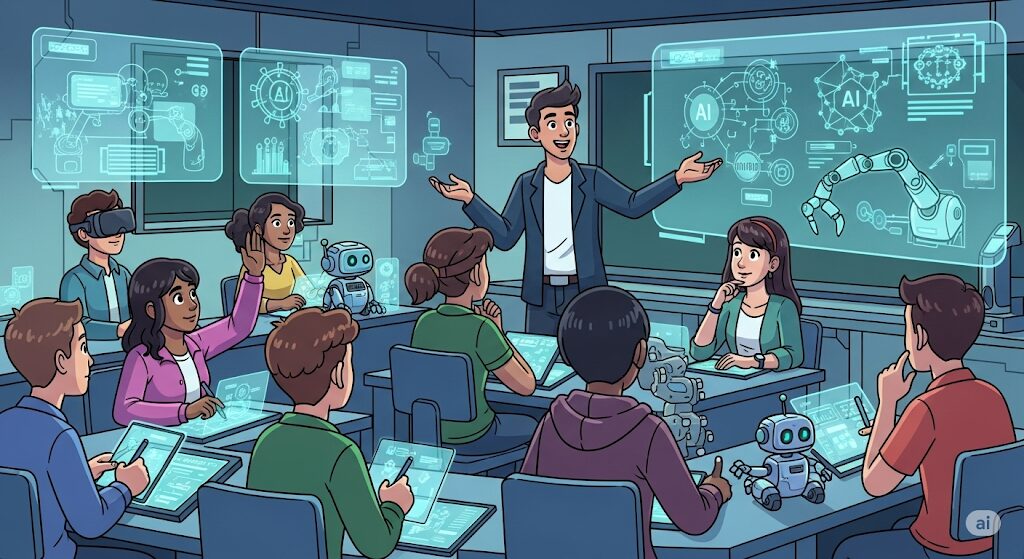
It was also evident from my own experience.
Approximately 15 years ago, at the dawn of the mobile era, companies recognized the importance of UI/UX that appeared alongside the iPhone and invested heavily. During that time, we were conducting internal training, seminars, and other activities in parallel with significant investment.
As a new employee at a major corporation at the time, I also remember taking related classes through instructors during my training.
At that time, the instructor was someone who had worked at the company for a long time before moving to lead a team within the company's HR Development Center; whenever the company requested it, they would diligently study the relevant technology or content to deliver the lecture.
It seems that the instructor also studied the importance of UI/UX at the request of the company and gave lectures on it.. Because he emphasized the process and importance of it several times during the lecture, I remember it clearly.
At that time, the instructor explained the story to us while extolling the virtues of Steve Jobs, saying, "Think and act like Steve Jobs!"

Among my peers, I was the only one who had been doing related web design work before joining the company and had experience with mobile service-related tasks, even reaching the final interview at a related company before choosing another company, so I was participating in this training. I had asked a question because I couldn't quite understand the instructor's lecture content.
"I don't quite understand what it means to think and act like Steve Jobs, as you mentioned. Could you please explain by sharing the actual projects or stories you have experienced?"
First, the instructor valued UI/UX and emphasized Steve Jobs' philosophy, but the presentation slides were not attractive at all, simply recounting that content.
He seriously asked the question with a realistic doubt, 'Have you worked on a project to improve UI/UX? If so, I would like to hear your story.'
Unfortunately, the instructor could not provide a proper answer because he had not experienced the relevant project. (And he was scolded for acting like he knew something despite being a newbie.)
That was likely the case, as while everyone recognized its importance at the time, there were very few teams in the country that had actually gained relevant experience, so the instructor likely did not have enough time to acquire sufficient experience.
Since new technologies and new concepts are literally "ahead of their time", one should have sufficient time to experience, digest, and understand them; however, the rapid development of the times often leaves no time for leisure and immediately requests professional education.
I, too, have experienced the bewilderment of receiving a request to teach a subject I was unfamiliar with to an institution. They told me that even if I refused, they could not find an instructor capable of teaching that lecture, so I had no choice but to study intensively for several weeks to deliver the lecture.
Therefore, for the sake of resolving these shortcomings, our universities, which are specialized in "knowledge" and "research", should properly fulfill their role and create a system where companies and many fields that can utilize this knowledge can achieve a win-win situation.
While the intention to have companies define their talent needs and universities collaborate to create curricula that meet those needs is good, having companies take the lead in creating such processes incurs a high "opportunity cost".

Of course, companies that already have an efficient talent development process could proceed by sharing their infrastructure with universities... (do they have it..? )
Companies that fail to do so will eventually have to invest to create processes or curricula, but if the benefits are unclear, it seems difficult for companies to invest, or they may worry that they will only make investments worse than the benefits and create the lectures mentioned earlier, "like Steve Jobs" .
I have actually been participating in mentoring from a corporate perspective at the request of universities for the past few years, and occasionally I see students who appear to grow rapidly if they are immediately deployed to the field and given opportunities for work.
So, I inquire with the school to see if they can hire while reducing the company's burden, or if they can provide other support to offer internships. Regrettably, opportunities were concentrated only on companies that had already hired large numbers of people, or there was no application at all, so I or the company had to bear the full burden to hire.
Since the position is that of a company that must nurture new hires who naturally need to balance education with practical work, the burden inevitably increases, making it impossible to push forward with everything. However, I believe it would be truly wonderful if, through such support projects, companies like mine could also participate in talent recruitment and development with less burden.
Although I mentioned a 15-year-old episode earlier, the world has developed rapidly since then, diverse knowledge content exists, and it has become an era where anyone can view it through YouTube.
Furthermore, not just large corporations' talent development departments, but many companies that make "practical" training their business, such as Udemy, Inflearn, and Fast Campus, have emerged, and students and job seekers are actively utilizing such systems.
Now that it is 2025, I hope that this project will become one where the essence of collaborating with companies and the effort to create programs that make that possible, as well as securing instructors, are clearly presented as appropriate rewards and benefits for schools, students, and companies alike, so that it does not become a project where someone posts a photo of 'Sam Altman' and gives a lecture like 'Think like OpenAI!!'.
It is so difficult to create lectures using new technologies and content that can immediately help students or be used in practice... Wouldn't proper compensation be needed to do it properly?
3. Limitations and Necessity of Development Led by the State
I was fundamentally critical of leading advanced technology under national leadership. After all, to possess the competitiveness to survive in the ecosystem, I held the thought that 'shouldn't companies grow on their own..? '
I came to have this awareness because of the BK21 project I experienced when I entered university, but those who attended engineering colleges in the late 1990s and early 2000s, similar to me, likely share a similar experience.
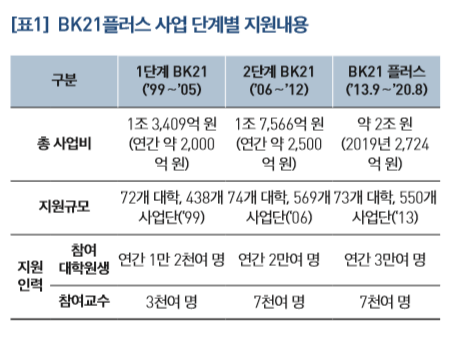
At the time, it was a project where the government led the development of science and engineering majors with significant investment, but from the perspective of a student, research assistant, and researcher within the university, it was a project with far too many flaws and areas that needed correction.
Of course, there were many responsible officials, schools, laboratories, and professors who carried out the project correctly and operated it with integrity, but I remember there were also many bad cases.

Having such experience and a critical perspective, I found myself viewing many of the government's actions with the mindset of 'Ah, there goes another tax grab.' after that.
However, based on my recent experiences, I have come to the realization that 'government-led investment is still necessary.'
The field I have mainly participated in or lectured, consulted, etc., over the past 10 years is the XR (extended reality) field, but while engaging in related activities, I was able to meet many strange companies, strange experts, and professors lacking expertise to the extent that I would think, 'Why on earth am I doing this..? ' So, perhaps for that reason, I seem to have looked at it even more critically, as mentioned above.
Of course, I worked hard and ran around with the intention of doing well for the country, but since an ecosystem had been created in that field as well, and I was an 'outsider,' I felt that my efforts were limited, so I thought I couldn't have a big impact and felt a lot of disillusionment.
However, when looking for cases for relevant lectures at universities that students can directly observe and experience, I found, 'Oh, really?' In the past five years, truly excellent XR production teams have emerged in Korea, and wonderful works are being revealed, exhibited, or engaged in commercial activities in various places in the actual space we live in.

When looking for the starting point of these projects, various capable companies led by national support projects gradually developed them, and the government support project became a shelter and a strong energy source that allowed them to start.
Although there were many negative cases and some who did not proceed properly, there were many teams that took the opportunity in line with the purpose and utilized that opportunity to grow and produce wonderful results.

At one time, a respected senior in the industry told me something like this.
"Typically, a business unit needs to be in the top 5% to keep the company afloat. However, for knowledge-based technology business units, it is not 5%, but 1%, or rather, just one outstanding individual can sustain everyone. Therefore, cultivating talent and ensuring outstanding talent enter this field is crucial."
I think that Meta (formerly Facebook) is also gathering AI core talent by paying an incredibly unreasonable salary recently.
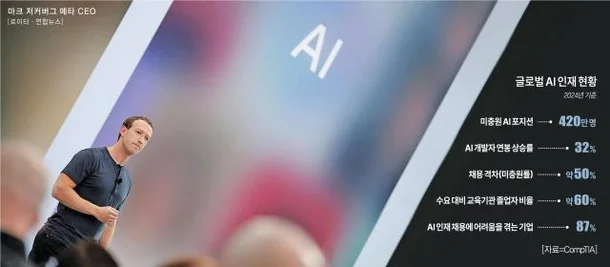
In particular, since Korea is a country lacking other mineral resources or physical resources, the most competitive resource the nation possesses is "human resources".
However, regrettably, in our country, we often see stories about the most outstanding talents choosing medical school over science and engineering or the technology market to become doctors over the past 20 years.
Actually, I remember being quite upset when my best friend in high school, who was the most outstanding among us, won a science-related international competition representing the country and came back. I naturally assumed he would major in science, but seeing him enroll in medical school according to his parents' wishes was quite regrettable.
If even 1 in 10, or 1 in 10,000, of the talent possessing such innate ability were to enter science and engineering fields under a national system and support, achieve good results, and expand into the industry to feed hundreds, thousands, and eventually millions, then that investment would ultimately be a successful one, even if it incurred significant losses.
I, too, invest my time in mentoring and lectures, utilizing my experience and knowledge as best I can. Occasionally, when the knowledge I possess bears fruit and students with talent begin to produce good results after receiving my small advice, as if waiting for nourishment, I experience a truly great joy.
The recent post about the PyeongChang camp is also part of that.
In particular, in this case, the professor who hosted the event later conveyed very grateful feedback... It makes me think that we did well to carry out such activities.

Of course, it is impossible to know if that student will achieve great success in that field ten years from now, but I believe that if the nation invests, the system is established, and the framework is solidified, opportunities will increase.
While viewing the national AI development project with a critical eye, I aim to actively participate and invest time to ensure it succeeds as much as possible.
I hope the product known as our country succeeds in providing a better future for our children.
Thoughts on the 'AI Advanced Industry Talent Bootcamp' Project..
When mentoring, I tell this story, half-seriously and half-jokingly.
'You will do well so that in the future you will be responsible for my four major insurances.!! '
Although this is just a joke for ice-breaking, if I think about it calmly, I believe that investing in today's 20s and 10s now is not too late, and that our country's future exists because of this, and furthermore, my own future, who has fallen behind in the field and suffered a significant decline in productivity, might be able to live a little more comfortably.
"Better Late Than Never"
I think it's better to do it even if it's late.
Our country's future may not lie in AI. New opportunities could open up through entirely different fields. However, I believe that if these opportunities are executed properly and we find methodologies through the process, we can cultivate a strong power to overcome many crises wisely.
Even so, I am investing time and money to make my own efforts, however meager, and I hope these efforts will be of some help.
So, I hope the four major insurances that guarantee my retirement are maintained healthily. (?)