
Today, I would like to introduce PandaAPI, a result of mentoring conducted to improve the capabilities of a university developer.
I have been mentoring several graduating Computer Engineering students at various universities for the past two years as a great opportunity... In their early years, I realized they struggled significantly with utilizing AI and were surprised to find that they had not had much experience building related services or using cloud-based services.
Actually, I personally believe that the Department of Computer Engineering is a relevant field that should actively utilize AI and learn the related discipline of using APIs based on cloud services, building backends, and developing services or applications based on that..
So for this year, we conducted some preliminary research and studied topics and mentoring styles that could help current students nearing graduation, and one of them resulted in the Panda API service we are introducing today.
https://github.com/Soonsoon-Factory/Panda-APIhttps://github.com/Soonsoon-Factory/Panda-API
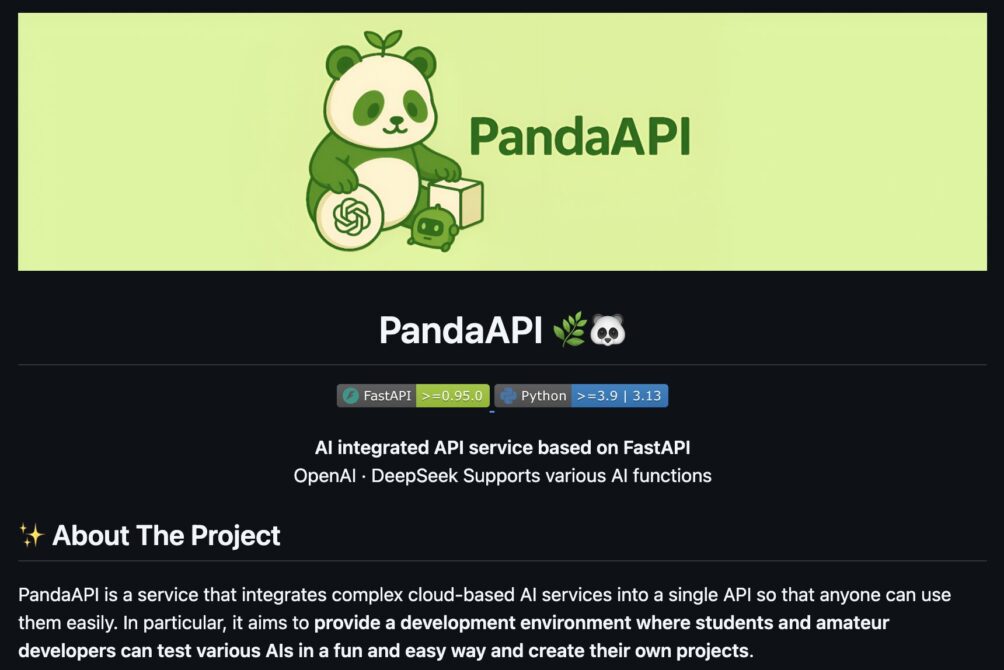
< Panda API, created and released by student Lee So-yeon currently studying Computer Science at Dongguk University >
PandaAPI is an API service for building a proxy-based backend that allows you to use LLM AI services available on Azure AI Foundry, which Microsoft operates on the Azure cloud.
Of course, you can already use Azure's APIs in API form, but you might ask why this is necessary. In reality, to use the service outside of the playground and in your own service or test environment, you have to separately set up the endpoint and secret key, so you inevitably have to write code in Python on the backend or locally to test it.
Of course, testing locally during this process is not a major issue, but ultimately, since all services should be considered "deployed" as the goal, exposing these endpoints and not exposing secret keys is the most basic security measure.
However, after actually working with students and projects, I found that while they had quite a bit of experience building Python-based local environments and running services as part of their curriculum, they had not experienced deployment using methods like Docker. Therefore, if the goal is to proceed with such deployment processes, I believed that building an API service that can be handled internally within a team or company, rather than directly exposing these basic AI services, and constructing an environment where AI services can be organically swapped out is an essential experience for software engineers and backend developers who work at companies creating and deploying AI-based services in the current situation.
Fortunately, the student understood this value well and conducted the project very diligently throughout the semester, allowing for a variety of educational sessions in a short period. One of the many results of this effort is this PandaAPI service.
If I have the chance, I wanted to share the direction of the mentoring I attempted this semester and the programs I performed, thinking that utilizing AI is essential for software developers in the future. Since Panda API was just released on its GitHub repository today, I think I can introduce this first, saying, 'I did this kind of thing before introducing other content.'
Panda API is built on FastAPI and follows the MIT license, making it available to everyone.